|
INDUSTRIAL WATER TREATMENT EQUIPMENT
RO PLANT
250 L/H
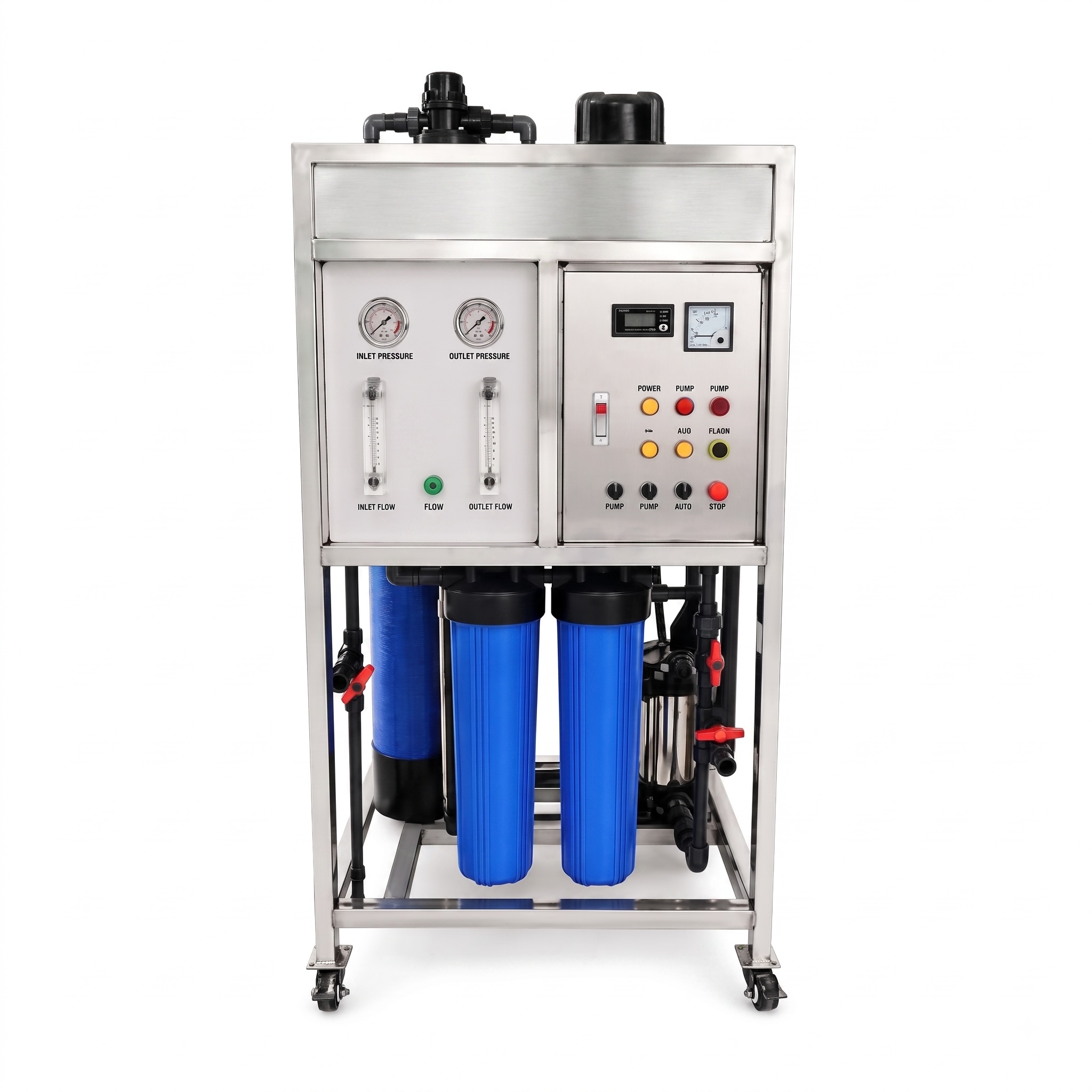
Compact single-membrane system · pretreatment + reverse osmosis · skid mounted · automatic
|
OUTPUT
250 L/H
|
PER 24 HOURS
6 m³
|
|
SALT REJECTION
≥ 97%
|
MEMBRANE
0.0001 µm
|
MODEL · RO-250
HS CODE · 8421219990
WARRANTY · 12 MONTHS | FEED TEMP · 10-40°C
OEM / ODM WELCOME
|
|
|
PROCESS FLOW
THE TREATMENT TRAIN
Pretreatment protects the membrane. Only the membrane removes dissolved salts. The reading in each row shows where the real drop happens — shown on 800 ppm well water.
| RAW WATER IN ↓ 800 ppm TDS |
01
IN
|
RAW WATER TANK
Buffer volume and float control, so the feed pump never runs dry. A 500 litre tank is usually enough at this capacity.
TDS 800 ppm
|
02
SF
|
QUARTZ SAND FILTER
Strips suspended solids, silt and turbidity down to about 20 µm. Backwash valve fitted as standard.
TDS 800 ppm · TURBIDITY DOWN
|
03
AC
|
ACTIVATED CARBON FILTER
Adsorbs free chlorine, organics, colour and odour. Chlorine destroys RO membranes, so this stage is not optional on municipal feed.
TDS 800 ppm · CHLORINE TO ZERO
|
04
SO
|
WATER SOFTENER (OPTIONAL)
Ion exchange removes calcium and magnesium so the membrane does not scale.
TDS 800 ppm · HARDNESS DOWN
|
05
PP
|
5 µm SECURITY CARTRIDGE
Final guard filter before the high-pressure pump. Cheap to change, protects everything downstream.
TDS 800 ppm · SDI DOWN
|
06
RO
|
REVERSE OSMOSIS MEMBRANES
A 0.75 kW vertical multistage pump drives the feed across a single 4040 brackish-water membrane at 10-15 bar. This is the only stage that removes dissolved salt.
TDS OUT ≤ 24 ppm · 97% REJECTED
|
07
UV
|
UV STERILIZER & TANK
254 nm disinfection on the outlet, then storage in the pure water tank ready for use.
PRODUCT WATER ≤ 24 ppm
|
| PURE WATER OUT ↓ ≤ 24 ppm TDS · 250 L/H |
» Output TDS scales with your feed water. 97% rejection applies to your water, not ours.
» At 50-60% recovery the unit draws 420-500 litres of feed per hour to make 250 L/H of permeate.
» Softener and UV stages are specified per water report.
» An online conductivity meter reads permeate quality continuously.
|
|
BEFORE YOU ORDER
SEND US THREE NUMBERS
An RO skid is configured against your feed water, not picked off a shelf. These three figures let our engineers confirm membrane count, pump head and recovery rate before anything is built.
|
01 · FEED TDS
In ppm or µS/cm
Under 2,000 ppm runs as the standard brackish-water configuration. Higher values change membrane type and pump selection.
|
| |
|
02 · WATER SOURCE
Well, municipal or river
This decides how much pretreatment you need. Municipal water can often skip the sand filter; well water rarely can. A standard tap supply is enough to feed this size.
|
| |
|
03 · POWER SUPPLY
Voltage, phase, frequency
Normally built for 220 V single-phase, 50 or 60 Hz, so no three-phase connection is needed. Tell us and the panel ships wired for your grid.
|
No water report? Send a sample result from any local laboratory, or tell us the region and the application — we have configured systems for buyers in over 100 countries and can start from comparable water.
|
|
TECHNICAL DATA · RO-250
SPECIFICATIONS
PERFORMANCE
| Permeate capacity | 250 L/H |
| Daily output at 24 h | 6 m³ |
| Required feed flow | 420-500 L/H |
| Desalination rate | ≥ 97% |
| Recovery rate | 50-60% |
| Membrane pore size | 0.0001 µm |
| Operating pressure | 10-15 bar |
| Feed water temperature | 10-40 °C |
| Recommended feed TDS | < 2,000 ppm |
CORE COMPONENTS
| High-pressure pump | Vertical multistage 0.75 kW |
| RO membranes | 1 × 4040 brackish water |
| Membrane housing | FRP pressure vessel |
| Pretreatment vessels | Stainless steel / FRP |
| Security filter | 5 µm PP cartridge |
| Frame | SS304 skid |
| Piping | UPVC / SS304 |
CONTROL & INSTRUMENTS
| Operation mode | Fully automatic |
| Water quality monitoring | Online conductivity meter |
| Pressure indication | Inlet, membrane, concentrate |
| Flow indication | Permeate + concentrate |
| Protection | High / low pressure cut-out |
| Fault handling | Alarm and indicator per fault |
| Auto flush | On start and stop |
| Power supply | 220 V single-phase, 50-60 Hz |
SHIPPING & COMMERCIAL
| Net weight | 130 kg |
| Gross weight | 190 kg |
| Package volume | 1.2 CBM |
| Packing | Film + wooden case |
| Machinery test report | Provided |
| Warranty | 12 months |
| Place of origin | Zhengzhou, Henan, China |
| HS code | 8421219990 |
| Annual production | 800 sets / year |
|
|
HOW IT IS BUILT
SIX THINGS THAT KEEP IT RUNNING
|
MEMBRANE LIFE
HIGH REJECTION, STABLE OVER TIME
Correct pretreatment keeps flux stable instead of decaying, so you clean on a schedule rather than every few weeks.
|
| |
|
FOOTPRINT
ONE SKID, FITS A CORNER
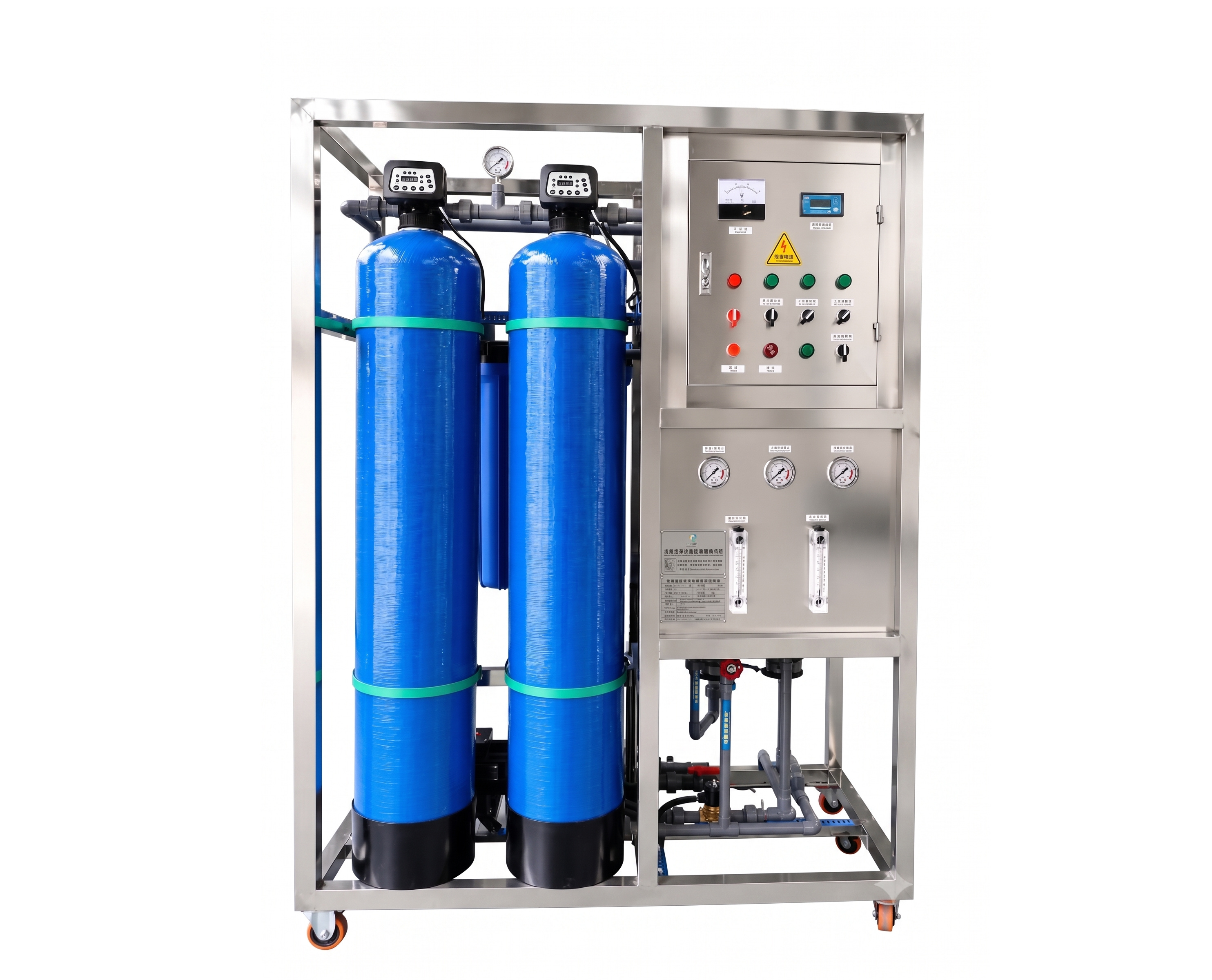
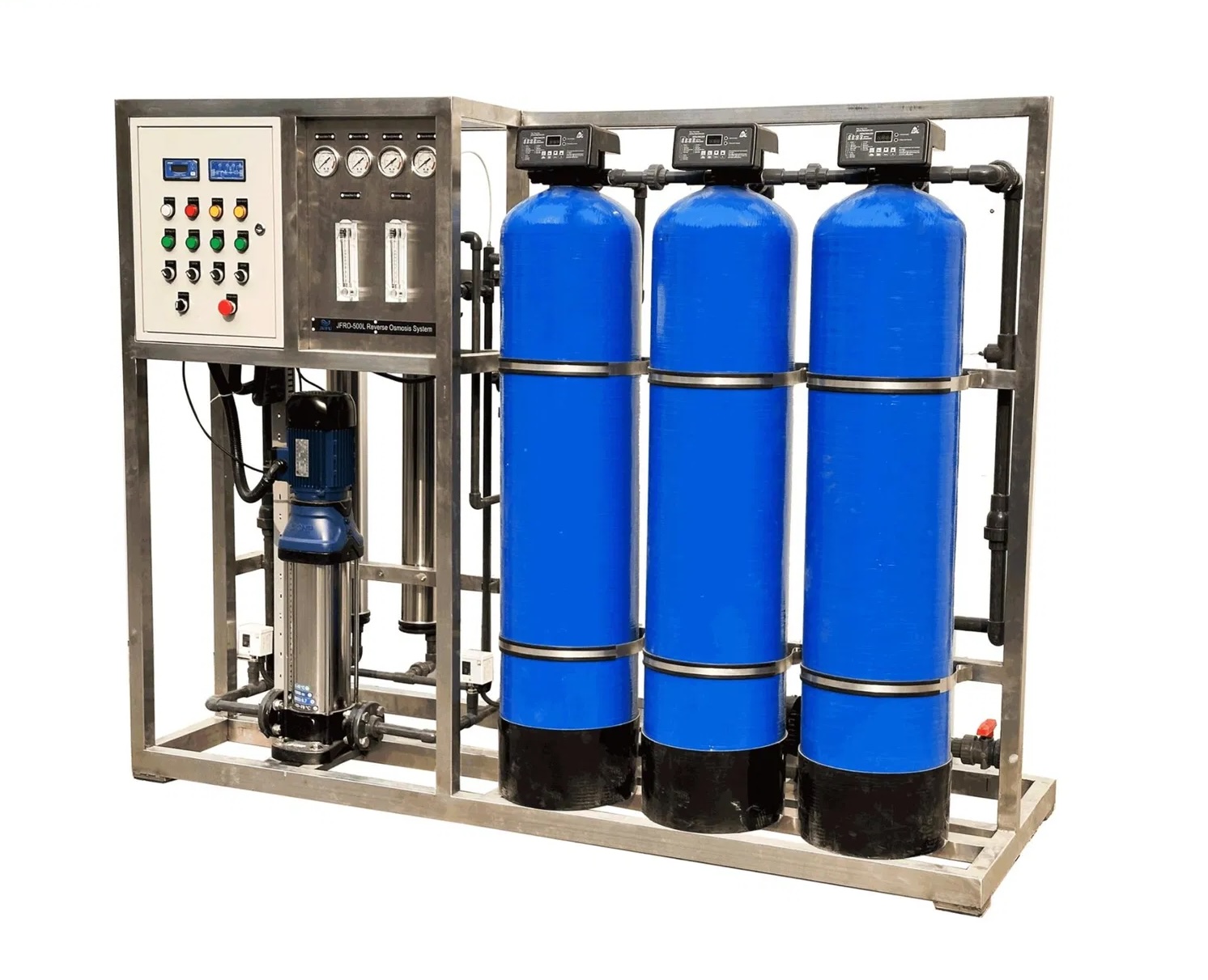
Pretreatment, pump, membrane and panel arrive assembled on a single frame roughly the size of a domestic fridge. Connect feed, drain, permeate and power.
|
| |
|
PUMP PROTECTION
HIGH AND LOW PRESSURE CUT-OUT
The pump stops if inlet pressure drops or membrane pressure spikes — the most common cause of field failures, guarded here in hardware.
|
| |
|
DIAGNOSTICS
FAULTS NAME THEMSELVES
Each protection trip lights its own indicator, so an operator can tell a low-inlet trip from an overpressure trip without a meter.
|
| |
|
WATER QUALITY
CONDUCTIVITY READ CONTINUOUSLY
Rising conductivity is the early warning that membranes need cleaning. You see it before your product does.
|
| |
|
SERVICE
DESIGN, BUILD, INSTALL
17 years producing water treatment equipment, with engineers carrying 24 years of field experience. One supplier from drawing to spare parts.
|
|
|
TYPICAL DUTY
WHERE A 250 L/H UNIT FITS
|
WATER SHOPS & REFILL
Refill outlets and 19 L jar filling for local delivery rounds.
|
| |
|
FOOD SERVICE
Coffee shops, ice machines, bakeries and small beverage batches.
|
| |
|
LABORATORY & CLINICS
Autoclave feed, glassware rinsing and pretreatment ahead of DI polishing.
|
| |
|
LIGHT INDUSTRY
Spot-free rinsing, battery top-up, cosmetics and small boiler make-up.
|
|
|
PACKING & DELIVERY
WHAT ARRIVES
|
IN THE CRATE
▪ Assembled RO skid with pretreatment vessels and membrane housing
▪ Membrane fitted, wet-tested and flushed before dispatch
▪ Control panel wired to your voltage and frequency
▪ Machinery test report and water quality result
▪ Installation drawing, operation manual and commissioning checklist
▪ Spare cartridge set and basic tool kit
|
EXPORT PACKING
Every unit is wrapped in protective plastic film, corner-protected and crated in a fumigation-free export wooden case. Vessels are strapped to the skid so nothing shifts in transit.
Shipping volume is 1.2 CBM at 190 kg gross, the cheapest size we make to ship. LCL sea freight is straightforward and air freight is realistic for urgent orders. We ship EXW, FOB or CIF and can consolidate tanks, filling lines or spare membranes into the same container.
OEM and ODM accepted: your brand plate, panel layout, colour, vessel material and stage configuration.
|
|
QUESTIONS BUYERS ASK FIRST
FAQ
Q. Will 250 L/H be enough for me?
Size against your peak draw, not your average. Running 24 hours gives 6 m³ per day; an eight-hour shift gives 2 m³, roughly 100 nineteen-litre jars. If demand sits close to the limit, add a larger pure water tank rather than a larger skid — storage is far cheaper than capacity, and this unit can fill a tank overnight.
Q. How much raw water does it consume?
At 50-60% recovery the unit needs about 420 to 500 litres per hour of feed to produce 250 litres of permeate. The rest leaves as concentrate, which many buyers reuse for washing, cleaning or irrigation. An ordinary mains tap supplies this comfortably.
Q. What TDS can the feed water be?
The standard configuration is built for brackish feed under 2,000 ppm. Between 2,000 and 10,000 ppm we change membrane type and pump head. Seawater at roughly 35,000 ppm needs a different system entirely — send your figure and we will quote the right one.
Q. How often do membranes and cartridges need changing?
The 5 µm cartridge is a consumable, typically every one to three months depending on feed turbidity. The RO membrane lasts two to three years on properly pretreated water. Rising permeate conductivity or falling flow tells you when cleaning is due.
Q. Does it produce drinking water directly?
RO permeate meets drinking water standards for dissolved solids, and the UV stage handles disinfection. For bottling you would normally add remineralisation or ozone depending on local regulations — we can include either stage.
Q. Are spare parts available after installation?
Yes. Membranes, cartridges, pumps and control components are stocked and shipped worldwide. Installation and commissioning support is provided by video call, with drawings and a written checklist supplied with the machine.
Q. What is the lead time?
Standard configurations ship in 7 to 15 working days after order confirmation. Customised stage layouts, non-standard voltage or OEM branding typically add one to two weeks.
|
|
NEXT STEP
GET IT CONFIGURED FOR YOUR WATER
Message us with your feed TDS, water source and power supply. You will get a stage-by-stage configuration, the expected permeate quality and a delivered price. Other capacities available from 250 L/H to 20 m³/h.
|